Buyer Advice
Price Cut or Rate Buy-Down? How to Ask for the Right Thing
The lowest price does not always mean the lowest monthly payment. Here is when to negotiate the price down and when seller concessions toward a rate buy-down do more for you.
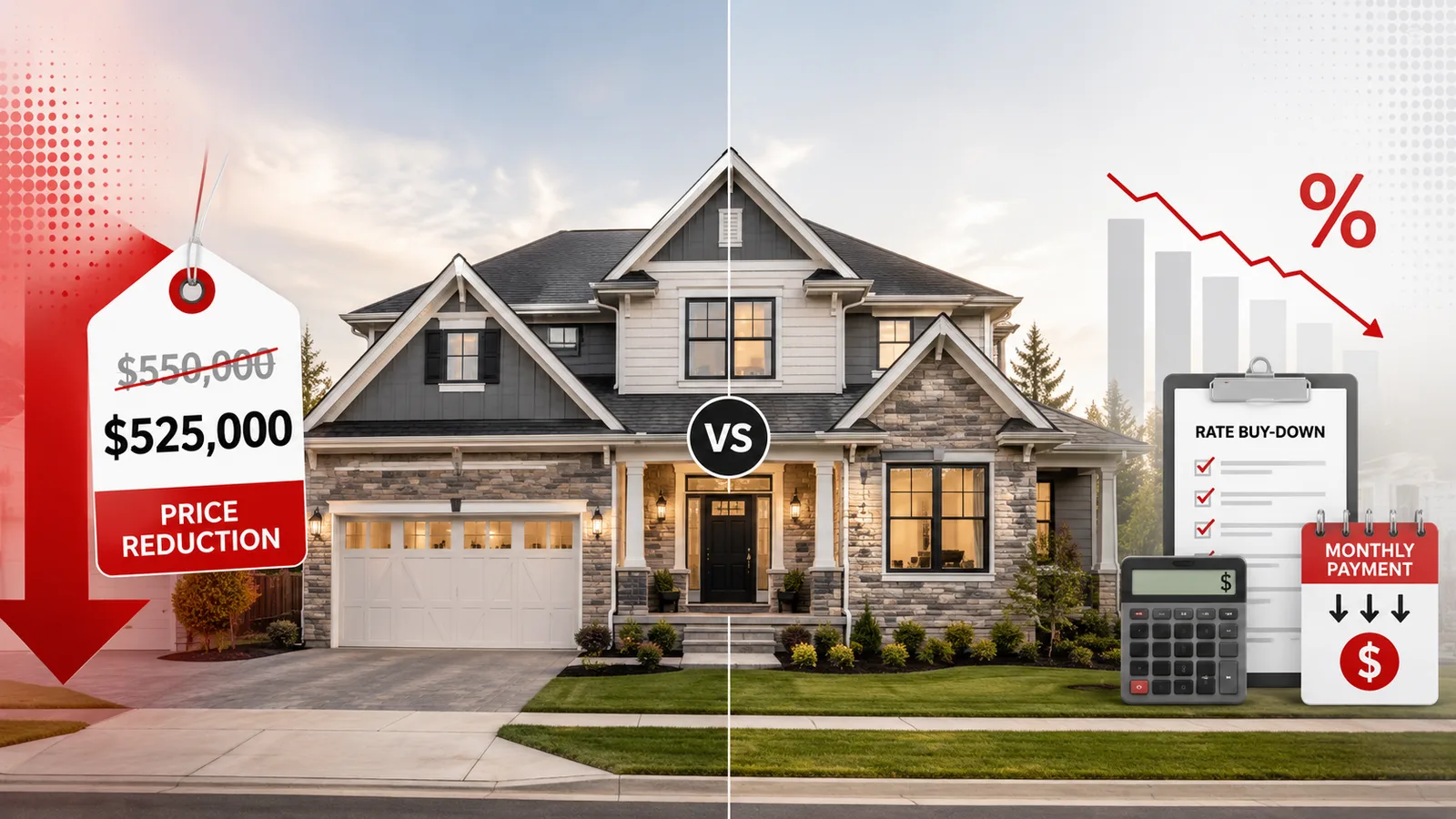
When buying a home, most people naturally focus on the sales price. That makes sense. The price is the big number everyone sees. It is on the listing, it is the number your friends and family ask about, and it is the number buyers tend to negotiate first.
But in today's market, the lowest price does not always mean the lowest monthly payment. Sometimes asking the seller for concessions to help buy down your interest rate saves you more month to month than a straight price reduction. Here is the difference.
What it means to ask for money off the price
Asking for money off the price means negotiating a lower sales price. If a home is listed at $400,000 and you offer $390,000 and the seller accepts, you saved $10,000 on the purchase price.
That sounds like a big win, and sometimes it is. But here is the part buyers often miss: a $10,000 price cut usually does not lower your monthly payment as much as people think. Depending on your loan terms, rate, taxes, insurance, and down payment, that $10,000 may only trim the payment by a relatively small amount each month. Helpful, but rarely life-changing.
What seller concessions are
Seller concessions are when the seller agrees to contribute money toward your closing costs, prepaid expenses, or other allowed loan costs. One powerful use of that credit is buying down your interest rate.
Instead of reducing the price, the seller gives a credit that lowers your rate. A lower rate can cut the monthly payment, often more than a price reduction would. So instead of asking the seller to drop the price by $10,000, you might ask for $10,000 in concessions toward a rate buy-down. The seller gives up $10,000 either way. The buyer often gets a bigger monthly benefit from putting it toward the loan.
Price reduction vs. rate buy-down: the simple version
Say you are buying around $400,000 and you have two options.
Option 1: ask the seller to reduce the price by $10,000.
Option 2: ask the seller for $10,000 in concessions to buy down the rate.
With the first, the loan amount drops slightly. That lowers the payment, but usually not by much. With the second, the rate drops, which can create larger monthly savings because you are paying less interest across the loan.
The exact numbers depend on loan type, lender, rate, down payment, and market conditions, but the idea is this:
A price reduction lowers the amount you borrow. A rate buy-down lowers the cost of borrowing. That second one can matter a lot when rates are higher.
Why this matters more when rates are high
When rates are low, buyers focus on price because the payment is already manageable. When rates are higher, the payment becomes the pain point. You may love a house but feel uneasy about the payment, and negotiating only on price might not fix the real problem.
If the issue is monthly affordability, a concession used to buy down the rate can be the smarter move. It is not always about getting the best deal on paper. It is about structuring the deal so it actually works after closing. Owning a home is great. Being house poor is just renting from your mortgage with extra chores.
Why sellers should care too
This helps sellers as well. A seller may not want to cut the price because they are protecting equity, neighborhood values, or appraisal support. Offering concessions can make the home more affordable to buyers without moving the headline price as much, which helps a listing stand out when buyers are watching the monthly payment.
For sellers the question is not always "how much do I drop the price." Sometimes the better question is "how do we make this home more attractive to buyers." Concessions may be part of that answer.
Is a rate buy-down always better?
No. A price reduction may be the better move if the home is overpriced, if you are worried about appraisal value, if you plan to refinance or sell soon, if the concession would not create enough monthly savings to justify it, or if the loan program limits how much the seller can contribute.
Concessions may be better if your biggest concern is the monthly payment, if the seller will negotiate but does not want to cut the price, if you have enough cash for the down payment but want help with loan costs, or if the buy-down creates stronger monthly savings than a price cut.
The right answer depends on your goals, the seller's motivation, and the loan structure.
Talk to your lender before making the offer
Before asking for concessions, talk with your lender. Different loan programs have different rules on seller contributions, and there are limits based on loan type, down payment, occupancy, and how the funds are used. A good lender can compare the options side by side:
- What happens if the price is reduced?
- What happens if the seller gives concessions?
- How much would a rate buy-down lower the payment?
- How long would it take to break even?
- Is a temporary or permanent buy-down better?
That is how you make a smarter offer instead of guessing, and guessing with hundreds of thousands of dollars is generally frowned upon by people who enjoy sleeping at night.
The bottom line
Money off the price and seller concessions are both negotiation tools, but they solve different problems. A price reduction lowers the purchase price. Concessions can lower the cash you need at closing or lower the monthly payment through a rate buy-down.
In a market where buyers are focused on affordability, concessions can sometimes be more useful than a simple price cut. The best move is to compare both before making an offer. A lower price feels good. A lower payment may help more.
If you are buying or selling in Schertz, Cibolo, New Braunfels, or the surrounding San Antonio area, get in touch and we will help you understand how each negotiation strategy affects the real numbers, not just the sales price.
This is buyer education, not financial or lending advice. Use it to ask your lender better questions and to structure your offer with your agent.
Have a question this didn't answer?
Ask us directly.
We're The Claus Team, and we actually live and work here. Happy to help, no pressure.